
New report highlights results of Project Development Assistance for Hydrogen Valleys
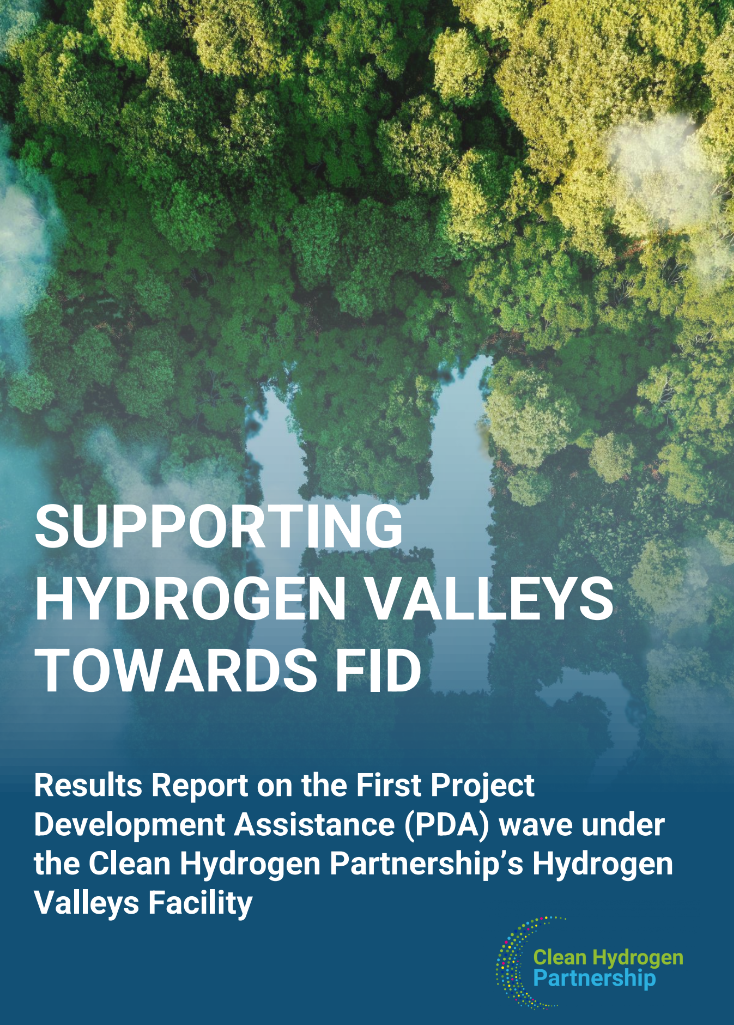
The Clean Hydrogen Partnership has published a new report presenting the results and key outcomes of the first Project Development Assistance programme for Hydrogen Valleys.
The PDA programme provided tailored support to 15 Hydrogen Valleys from eight EU Member States and three countries associated to Horizon Europe, helping project promoters advance their concepts and strengthen their readiness for further development and investment.
The 15 projects were supported through two PDA tracks: nine PDA light projects, focused on moving from idea to concept stage, and six PDA plus projects, supporting more advanced projects from concept to feasibility and ultimately towards final investment decision.
Delivered by Roland Berger and Worley, the assistance covered four key dimensions: commercial, technical, regulatory and governance support. This included work on hydrogen market demand, offtake and pricing; optimisation of techno-economic assumptions; refined CAPEX and OPEX structures; understanding of regulatory requirements, including RED III, RFNBO and low-carbon hydrogen Delegated Acts; and support for effective project governance and milestone planning.
The results show that all participating projects made significant progress towards final investment decision and were able to unlock tangible improvements. On the commercial side, the PDA support helped projects validate willingness-to-pay assessments, structure offtake pipelines, improve business cases and initiate discussions with investors.
On the technical side, projects identified up to 25% levelised cost of hydrogen optimisation potential across more than ten technical levers, while also refining CAPEX and OPEX cost estimations. The programme also generated project-specific demand-pull insights under key regulatory frameworks, including RED III, FuelEU Maritime and the ReFuelEU Aviation Regulation.
In addition, the support helped project promoters structure complex multi-component project set-ups, identify cross-project synergies and, in some cases, establish effective Hydrogen Valley governance models covering more than 20 sub-projects.
The publication of the report comes as the second Call for Applications for PDA support is now open. Applications can be submitted until 26 June.
Interested applicants are also invited to join two online Information Days, taking place on Tuesday, 12 May and Tuesday, 19 May, which will present the PDA programme, the application process and the support available.
More information and application details are available at: PDA - H2V